

Display performance is not defined at normal incidence. In real-world conditions, viewing angle, lighting, and surface treatments drastically impact readability, yet these effects are rarely predicted accurately before prototyping.
The objective of this project was to predict the perceived performance of a smartphone display under real-world conditions, including:
- Multiple viewing angles
- Real-world lighting environments
- Surface treatments (anti-reflective coatings)
Step 1: Capturing the true emission behavior of the display
The first step in this project consisted in building a physically accurate emission model of the display, capturing:
- Spectral behavior of RGB channels
- Intensity-dependent emission
- Angular distribution of emitted light
This step ensures that the simulation is predictive, not approximated.

We set up a protocol to measure the three primary colours of the screen: red, green and blue, for nine different levels of intensity, from minimum to maximum. In order to simulate the appearance of the information returned by the screen, we interpolated between these various levels of intensity for each channel, according to the triplets of colours transmitted by the screen.
Step 2: Evaluating display readability across viewing angles
Using the characterized model, the display was simulated under multiple viewing configurations to assess:
- Brightness drop-off
- Color shift
- Contrast degradation
This enabled engineers to predict user experience beyond on-axis performance, using Ocean™ as decision tool for readability validation.


Step 3: Quantifying the impact of anti-reflective treatments
A virtual anti-reflective coating was applied to the display glass to evaluate its impact on:
- Parasitic reflections
- Screen readability
- Visual comfort
Both appearance and optical performance were compared to quantify trade-offs, allowing engineers to validate coating strategies before physical prototyping.

Results & key outcomes:
In this use case, Ocean™ enables data-driven decisions on display performance before manufacturing and a better alignment between design, engineering, and user experience.
-
Accurate prediction of display appearance under multiple angles
-
Quantified improvement of readability with AR coating
-
Ability to compare design options without physical samples
-
Faster decision-making in early development stages
For this project, we implemented different advanced characterisation methods for an accurate and exhaustive simulation of the considered phone. Thanks to predictive optical simulation, our client has been able to propose material alternatives quickly and without manufacturing physical samples.
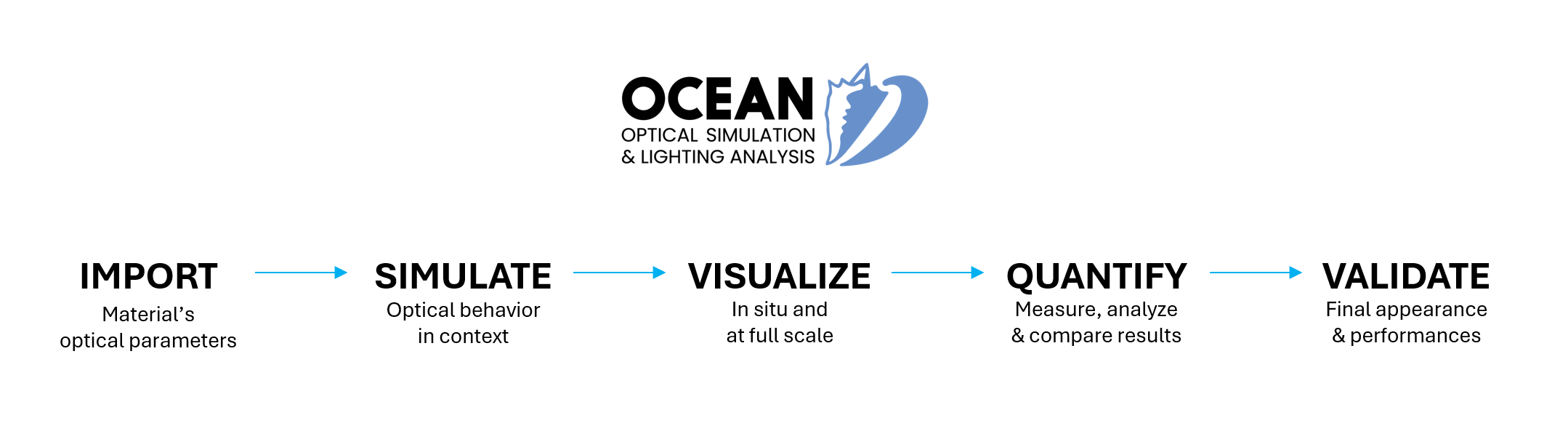
Validate appearance and performance
Accelerate design iterations
Get the physical prototype right the first time


