

How predictive optical simulation enabled lightweight, mono-material lighting design from concept to demonstrator:
Context & Challenge:
Co-develpment with Covestro of an advanced infinity light demonstrator in polycarbonate, exploring ultra-thin, mono-material architectures for automotive lighting. The workflow directly applies to interior and exterior automotive lighting systems, where optical performance, weight, packaging, and industrial feasibility are tightly coupled.
The challenge was to explore ambitious optical concepts while controlling risk, by understanding material behavior, light propagation, and manufacturability early to avoid physical prototypes iterations.
Iterations on absorbance range to optimize light propagation of wave pattern. From left to right: 40%, 10%, 1%
Ocean™ simulation approach:
Ocean™ was used as a system-level predictive optical simulation tool, enabling fast, digital iteration across material, geometry, and lighting strategy.
Rather than evaluating material appearance in isolation, Ocean™ allowed Covestro to:
- Simulate edge-light injection strategies across complex geometries
- Analyze light propagation in ultra-thin polycarbonate walls
- Evaluate diffusion patterns, textures, and pattern interactions
- Anticipate manufacturability constraints and perceived visual homogeneity
Predictive simulation shifted trial-and-error into a fast, digital environment, enabling early understanding of optical limits and real-world behavior.
Iterations on micro-pattern structures to reproduce the designer intent. Left: theoretical diffusive surface. Middle: iterations. Right: Final choice: 200µm diameter every 150 µm.
Results & engineering outcomes:
System-level optical validation
Material appearance and optical performance were validated within the complete lighting system, not as isolated samples.
Outcome:
Predictable lighting performance with strong correlation between simulation and physical behavior.
Mono-material functional integration
Simulation confirmed that optical and aesthetic functions could be integrated within a single polycarbonate material system.
Outcome:
No adhesives part separation and improved recyclability to align with Covestro’s sustainable economy objectives.
Lightweight & space-efficient architectures
Rigorous application of physics enabled confident exploration and validation of ultra-thin geometries while preserving optical quality.
Outcome:
Up to 30% weight reduction. Compact architectures freeing valuable space and reducing total weight.

Wave shapes engineering to enable effective light transport across all reflective elements and validate stable infinity propagation effect.
Measurable gains and customer satisfaction:
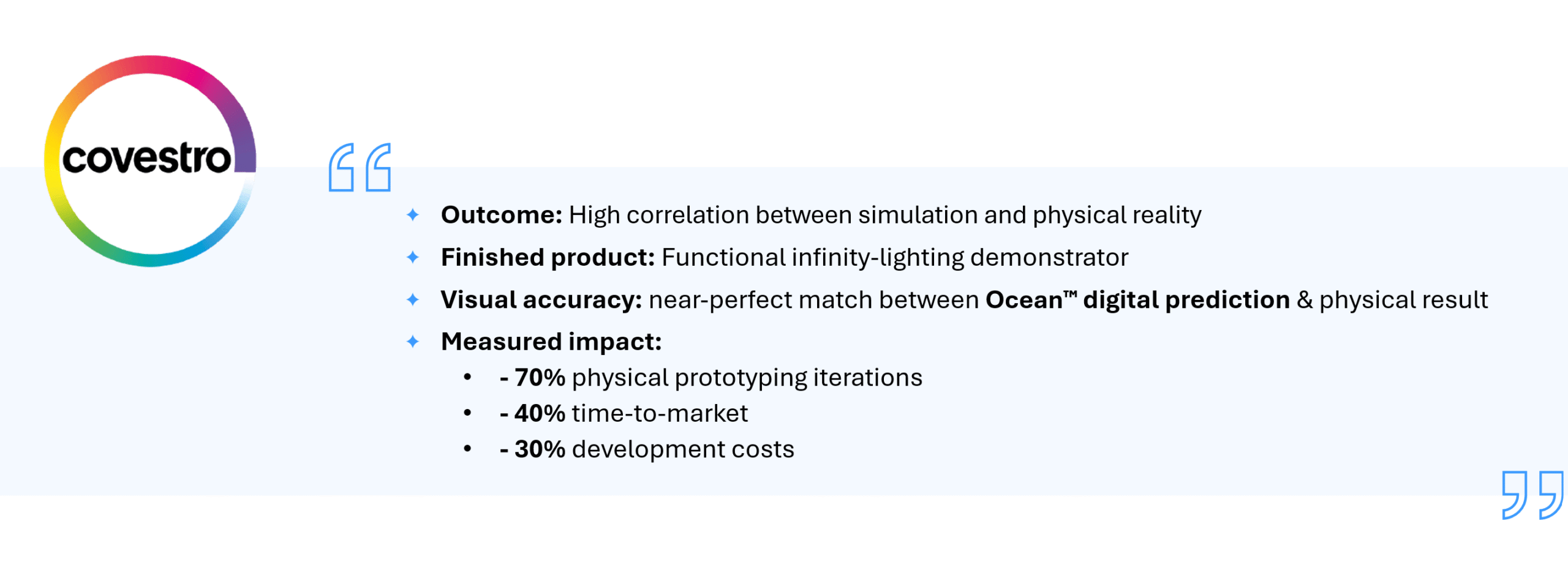
Faster, lower-risk development
- System-level validation of material performance.
- Reveal propagation effects, and manufacturing constraints early.
- Faster qualification of advanced lighting concepts.
Benefits for OEMs & end customers
- Lighter, more compact lighting systems.
- Predictable optical behavior in real conditions.
- Simplified, recyclable mono-material components.
Iterations on diffusive insert to achieve optimal optical performances with minimal thickness. Left: 2,5mm thick insert. Right: 2mm thick insert.


