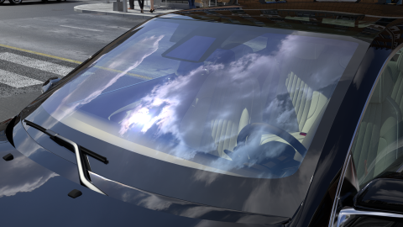
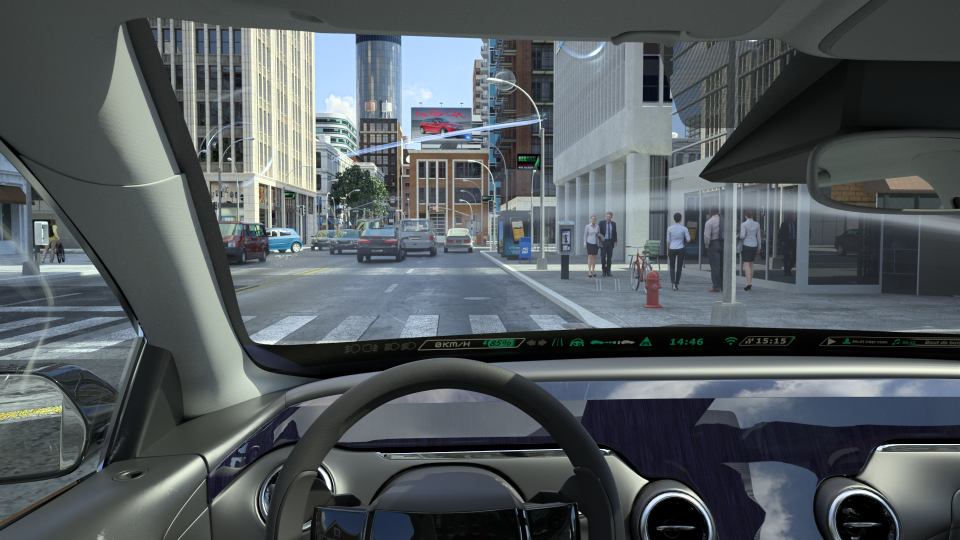
Achieving target luminance contrast in Head-Up Displays requires a precise characterization of the optical stack. Performance is dictated by the spectral response of the windshield glazing and the impact of ambient glare, necessitating a model that accounts for P-polarized light extinction when viewed through polarized lenses.
These effects are typically validated late through physical prototypes, making optimization slow, costly, and difficult to iterate.
The objective of this project was to evaluate and optimize a new windshield coating developed by a glassmaker to improve HUD performance, in order to:
Assess readability and image quality in real driving conditions
Evaluate performance with and without polarized sunglasses
Quantify the impact of the coating on both optical performance and perceived appearance
Ocean™ delivers both visual rendering and quantitative analysis for comprehensive evaluation of optical performance. For confidentiality reasons, only the rendering outputs are shown in this use case.
Step 1: Reconstructing the full HUD system
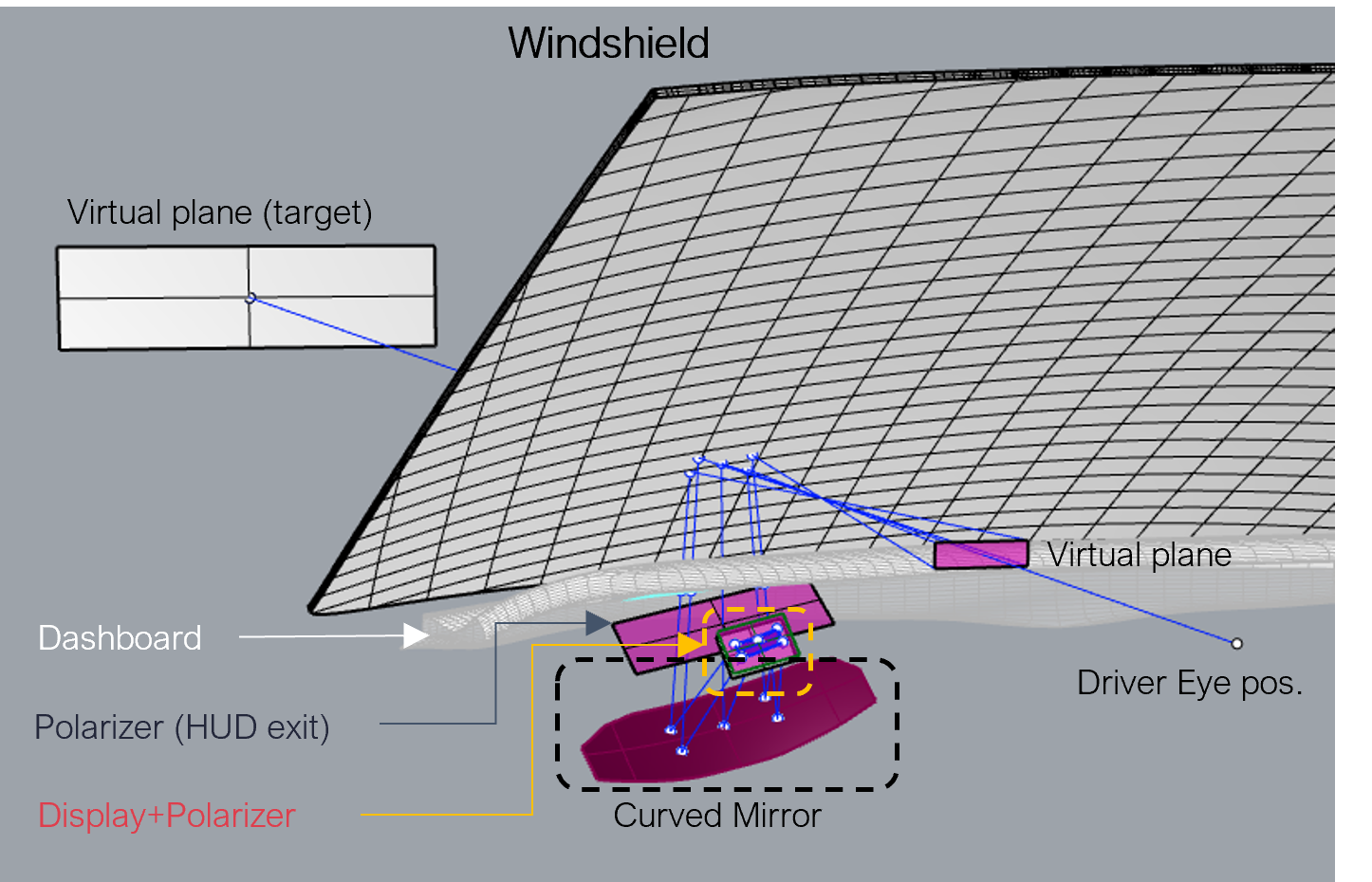
The first step consisted in building a physically accurate model of the complete HUD system using customer data, capturing:
3D geometry (windshield, HUD system, dashboard, driver eye position)
Optical properties of materials (glass, coatings, PVB, interior components)
Emissive behavior of the display (intensity, spectrum, emission profile)
This enables a consistent system-level simulation, from component behavior to in-vehicle perception.
3D Head-Up Display
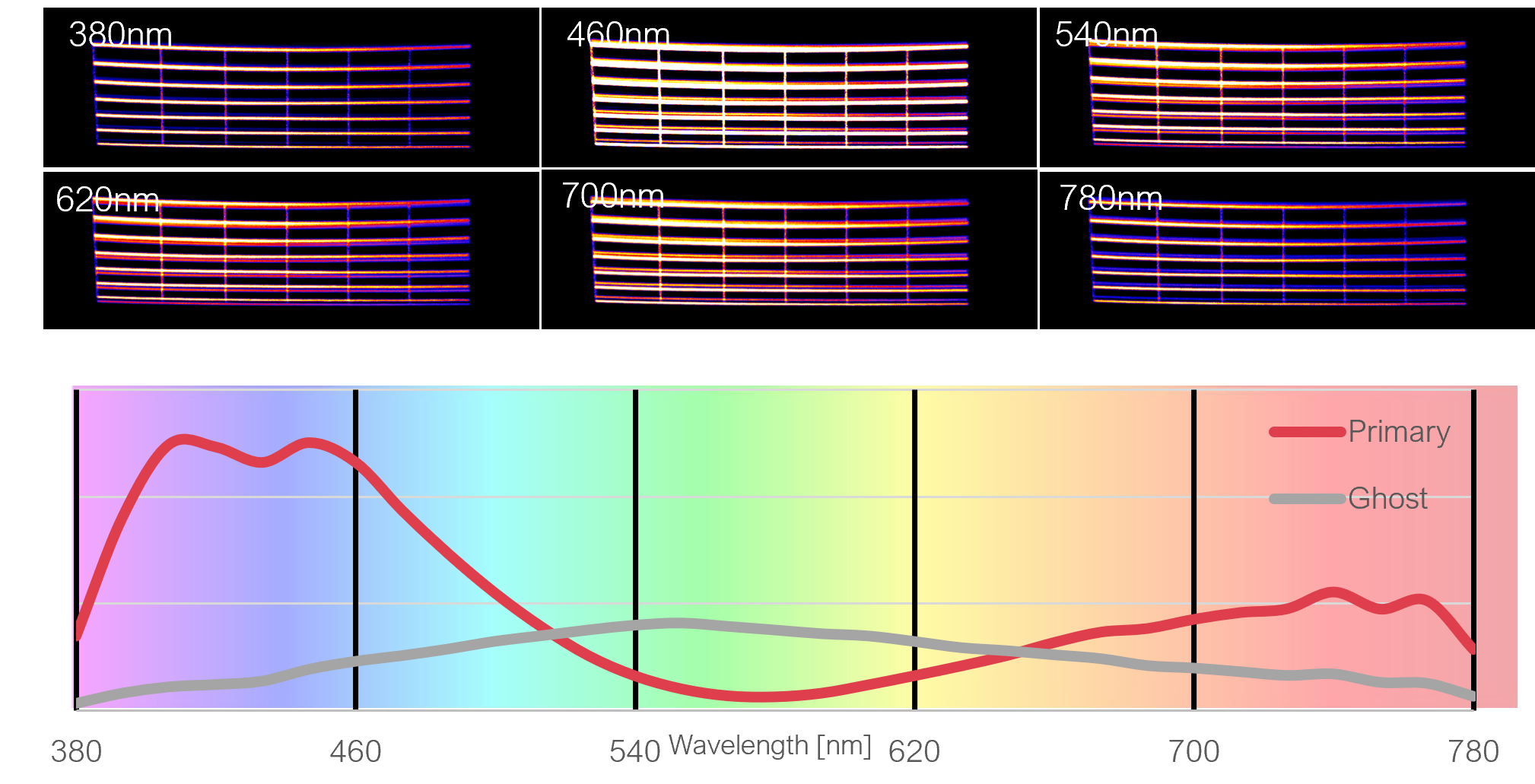
Hyperspectral imaging
Step 2: Refining the model for realistic driving conditions
The model was refined to integrate key parameters impacting real-world perception:
These refinements ensure that both optical performance and perceived appearance are accurately represented.
Step 3: Evaluating HUD performance and driver perception
Using the reconstructed model, the HUD system was simulated to evaluate:
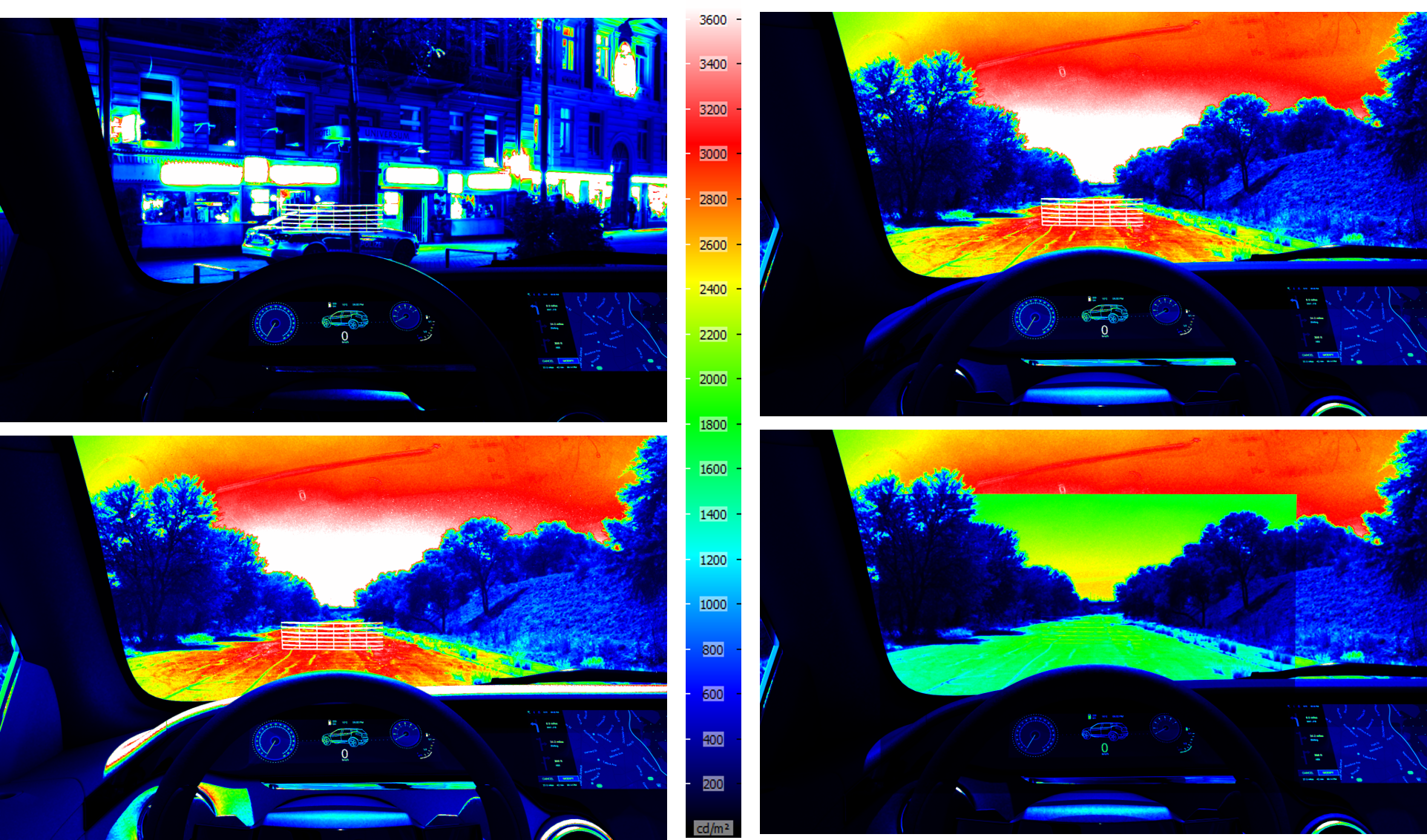
Image brightness and contrast
Readability across driver positions and conditions
Impact of polarized sunglasses
Presence and intensity of ghost images
Left: No polarizing filter – Right: Polarizing filter
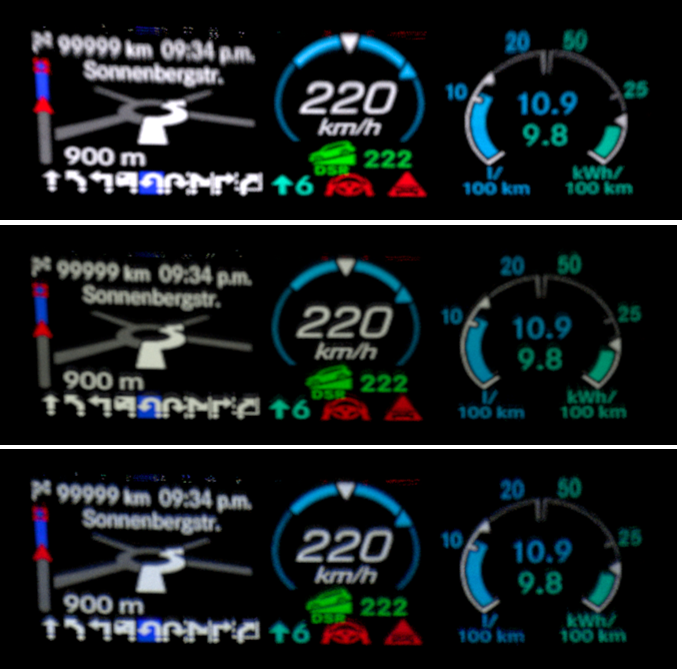
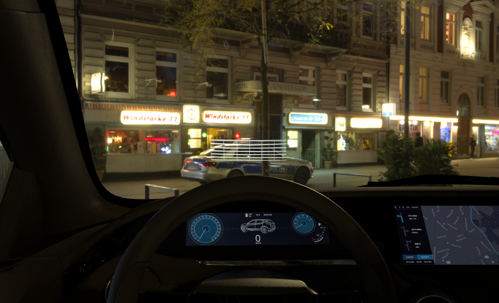
Visualization of perceived appearance for brightness and contrast iterations
To support these evaluations, multiple types of analysis were performed within the same simulation framework:
Geometrical analysis to understand optical paths, distortions, and ghost image formation
Illumination analysis to quantify luminance, contrast, and energy distribution
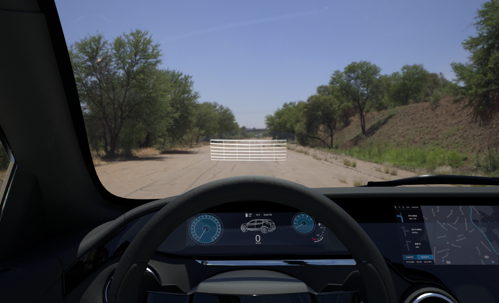
Appearance analysis to assess perceived image quality in real world driving scenarios
Geometrical analysis
Appearance analysis
Illumination analysis
Because all analyses are performed within a single, physically consistent environment (Ocean™), it enables to seamlessly:
Link physical phenomena to perceived performance
Identify root causes of visual issues (ghosting, contrast loss, distortions)
Compare design options with both quantitative metrics and visual validation
Make informed decisions early, before physical prototyping
Step 4: Optimizing coating strategies and extending to PHUD applications
Based on these system-level simulations, the glass manufacturer was able to evaluate multiple coating configurations in real world driving conditions and refine its development strategy accordingly.
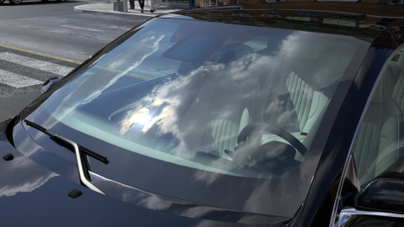
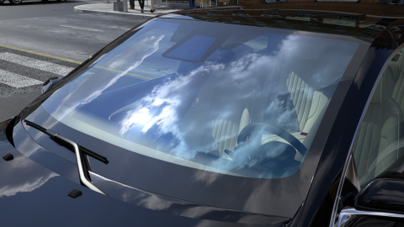
No coating
Coating #1
Coating #2
Beyond conventional HUD configurations, the same simulation framework was also applied to Panoramic Head-Up Display (PHUD) scenarios, where larger projection areas and more complex geometries further increase system sensitivity enabling to:
Validate coating strategies before physical prototyping
Extend solutions to next-generation HUD architectures (PHUD)
Reduce development risks when scaling to more complex systems
Ensure consistent performance across multiple use cases
PHUD simulation – PPOL on blackband
Results & key outcomes:
Ocean™ provides a predictive framework for assessing HUD legibility under real-world luminance conditions, allowing for the characterization of optical coatings prior to physical prototyping.
Rapid virtual iterations (minutes instead of months)
Empirical validation of performance targets to support definitive design-stage decisions.
Faster comparison of materials and optical parameters strategies
Reduced need for physical prototypes
The HUD assembly was characterized using native CAD geometry and empirical material datasets. This predictive modeling framework enabled the glass manufacturer to iterate coating specifications virtually, accelerating the delivery of high-performance glazing solutions to OEMs.
Key take awayPredictive simulation of the full HUD system enables engineers to anticipate both optical performance and driver perception, reducing development time and de-risking design decisions early.