

Context - Challenges in architectural glazing selection
Architects and industrial professionals in building materials face challenges when determining the aesthetic and functional performance of glazing materials for building facades. Questions often arise:
- What will be the perceived color of the material?
- What will the building look like under overcast sky? Under direct sunlight? At night?
- Will there be undesirable distorted reflections?
- How much shading will the glass provide?
- Will the glazing allow visibility inside the building, or will it primarily reflect the surroundings?
Traditionally, these assessments required building costly physical mock-ups, which is both time- and resource-intensive.
Objectives - Glazing performance analysis
In this case our collaboration focuses on enabling clients to:
- Compare the visual and functional characteristics of various glazing options.
- Accurately predict the performance of materials, including shading, reflection, and distortion effects.
- Make informed decisions to ensure the facade aligns with both design and practical requirements.
Eclat Digital Solutions - Advanced Virtual Prototyping with Ocean™ Software
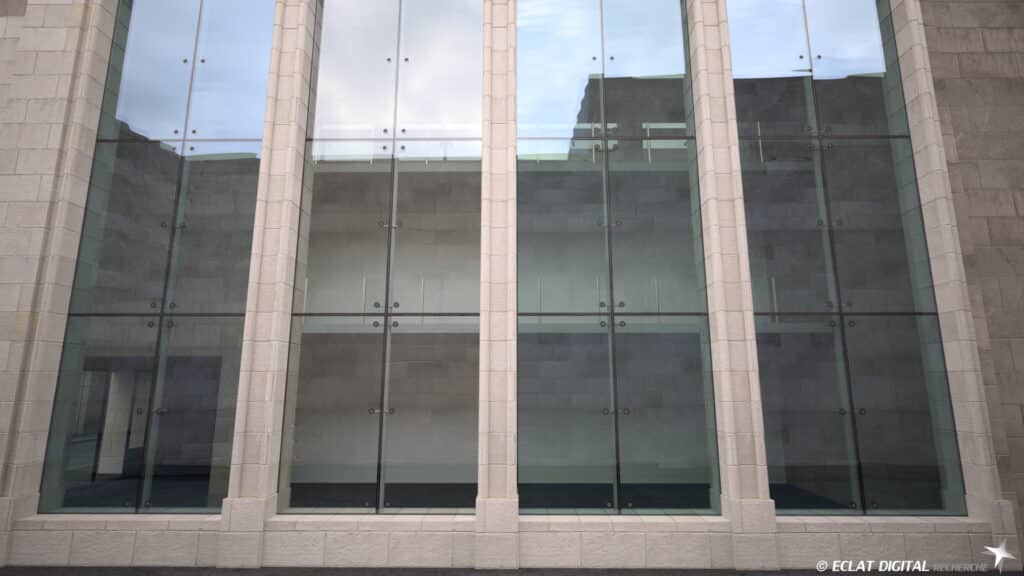
Using Ocean™ software, we deliver advanced virtual prototyping solutions tailored to the needs of architects and industrials. For this project, we compared four glazing types on a refurbished glass facade inspired by a real building:
- Blue Tinted Float Glass (6mm)
- Clear Float Glass (6mm)
- Low-E Coating A (6mm)
- Low-E Coating B (6mm)
Each glass unit shared identical thickness (6mm) and spacing (16mm), with a clear float glass counterpane. Simulations were performed under a cloudy sky condition using a real hemispherical sky picture. Our approach includes:
- Spectral and polarization-based calculations: Accurately reproduces the physical interaction of light with materials, including the effect of polarization.
- Precision modeling of visual distortions: Accounts for tempering-like effects and thermal bending.
- Full interior lighting accuracy: Incorporates light filtering through glazing materials.
These glazing simulations provide architects and industrial professionals with a powerful, cost-effective solution for evaluating glass facade designs.

Left to right : Blue float, Clear float, Low-E Coating A, Low-E Coating B
Results and benefits of glazing simulations
With Ocean™ virtual prototyping software, our client gained a detailed understanding of the glazing materials’ real-world appearance and performance without building physical samples. Key benefits included:
- Clear comparison of perceived color and reflections across glazing types.
- Evaluation of shading and privacy performance under accurate lighting conditions.
- Cost savings by eliminating the need for physical mock-ups.
- Faster, data-driven decision-making for facade design and material selection.
This rigorous scientific approach allows architects and industrials to refine their designs while maintaining budget and sustainability goals.

Need more information? Contact us

Q&A
What is Ocean™ virtual prototyping software?
Ocean™ is an advanced ray tracing software developed by Eclat Digital. It generates physically accurate virtual prototypes by simulating the optical properties of materials, such as coated glass, under various lighting conditions. This allows architects and industrial professionals to visualize and evaluate material performance without the need for physical samples.
How does Ocean™ assist in selecting glazing materials for building façades?
Ocean™ enables users to compare different glazing options by accurately simulating their visual and performance characteristics, including color perception, reflectivity, and shading capabilities. This helps in making informed decisions tailored to specific design requirements.
Can Ocean™ simulate real-world lighting conditions?
Yes, Ocean™ can simulate complex lighting scenarios, such as overcast skies or direct sunlight, providing a realistic visualization of how materials will appear in various environmental conditions. It enables the use of real-world weather data for even more accurate simulations.
What are the benefits of using virtual prototyping with Ocean™ in architectural design?
Utilizing Ocean™ for virtual prototyping offers several advantages, including cost savings by eliminating the need for physical mock-ups, the ability to explore multiple design options quickly, and the capability to identify and address potential issues early in the design process. Explore our solutions for architectural design and contact us for more details.
Is Ocean™ suitable for materials other than glass?
Yes, Ocean™ is versatile and can simulate a wide range of materials, including metals, plastics, and coatings, making it applicable for various industries beyond architecture.
How does Ocean™ ensure the accuracy of its simulations?
Ocean™ virtual prototyping software employs full-spectrum calculations, exact geometric optics, and considers light polarization to produce highly accurate and physically true virtual prototypes.
Can Ocean™ help in identifying potential visual distortions in glazing materials?
Yes, Ocean™ can simulate and detect optical artifacts and glass defects, such as visual distortion and birefringence, allowing these issues to be addressed early in the design process.


Responses