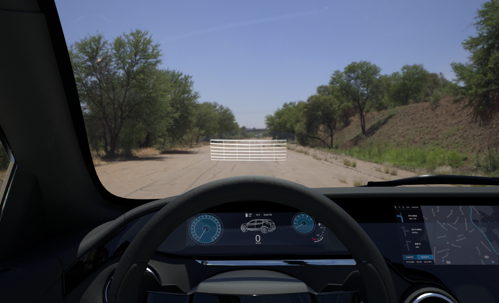
In the automotive industry, light is no longer just a source of illumination; it has also become a functional and safety-critical component, as well as a branding tool.
Adaptive lighting systems, digital displays, head-up displays (HUDs), LiDAR, cameras, illuminated surfaces and optical materials all interact with increasingly complex environments. As these technologies evolve, validating their behavior before physical prototyping has become a major engineering challenge.
At SIA Vision 2026, Eclat Digital will showcase how Ocean™, our physics-based optical simulation software, helps engineering teams accurately predict optical performance, visual appearance and human perception under real-world conditions.
Avoid late-stage surprises in optical performance with physically accurate optical simulation.
Modern vehicles integrate dozens of interacting optical systems. A change in material, coating, geometry or ambient lighting can affect not only the appearance of a product but also its optical performance and the driver’s perception.
Many engineering teams still discover issues late in development, including:
Unwanted reflections on windshields or displays
Stray light affecting cameras or LiDAR
Optical artefacts caused by multilayer materials or coatings
These issues often appear only after expensive prototypes or vehicle testing.
Ocean™ helps identify and validate them much earlier through physically accurate optical simulation.
Physics-Based simulation for automotive optical engineering
Ocean™ is designed for engineers who need predictive results, not simply realistic images.
Unlike conventional rendering or simplified optical simulation tools, Ocean™ combines:
Full spectral simulation to reproduce wavelength-dependent optical phenomena.
Polarization-aware light propagation for accurate modelling of coatings, glazing and optical assemblies.
Bidirectional path tracing to efficiently solve complex light transport.
Large-scale scene simulation to evaluate complete vehicle environments.
Physically accurate material models built from measured optical properties.
Quantitative optical analysis alongside predictive renderings.
This unique combination enables engineers to validate both optical performance and perceived appearance before manufacturing.
Applications we'll showcase at SIA Vision 2026
Predict driver vision & visual comfort
Driver perception directly impacts both safety and user experience.
Ocean™ enables engineering teams to evaluate visibility under real-world driving conditions while predicting:
Windshield and cockpit reflections
Veiling glare
Driver discomfort
Contrast loss
Night driving performance
Human visual perception
Evaluate complete driving scenarios before physical testing.
Design Readable Displays, HUDs & Illuminated Interfaces
Automotive HMIs must remain readable under all lighting conditions.
Ocean™ predicts the visual performance of:
Digital instrument clusters
Center displays
Head-up displays (HUDs)
Ambient lighting
Illuminated controls
Hidden-until-lit components
Light guides and illuminated trim
Optimize readability, brightness, contrast and perceived quality before hardware development.
Optimize Camera, Sensor & LiDAR Performance
Modern ADAS systems rely on accurate optical information.
Ocean™ enables engineers to simulate:
Camera vision
LiDAR systems
Sensor covers
Optical filters
Protective glazing
Environmental lighting conditions
Evaluate how reflections, scattering, coatings and ambient illumination affect sensor performance before system integration.
Detect optical artefacts before prototyping
Complex optical systems often generate subtle defects that are difficult to predict using simplified models.
Ocean™ helps identify:
Ghost images
Stray light
Parasitic reflections
Hot spots
Haze
Scattering
Color shifts
Non-uniform illumination
Coating interactions
By reproducing real optical phenomena, Ocean™ allows teams to resolve these issues earlier and reduce costly design iterations.
Why Ocean™?
Ocean™ is built around one objective: predict reality with physics. Its unique capabilities combine full-spectrum optical simulation, polarization modelling, bidirectional path tracing, physically accurate light transport and measured material characterization, enabling the simulation of complete vehicle-scale scenes and validation under reallighting and environmental conditions.
Instead of relying on approximations or idealized environments, Ocean™ enables engineers to validate designs under the same conditions in which products will ultimately be used.
The result is greater confidence in design decisions, fewer physical iterations and faster development cycles.


Responses