Introduction
- The base emission spectrum
- The position modulation function, allowing to make the emittance depend on position in space. For instance, a grey-scale image may be used for modulating the object luminance.
- A distribution function controlling the dependence of light intensity with direction in respect to the object’s surface.
Complex light sources

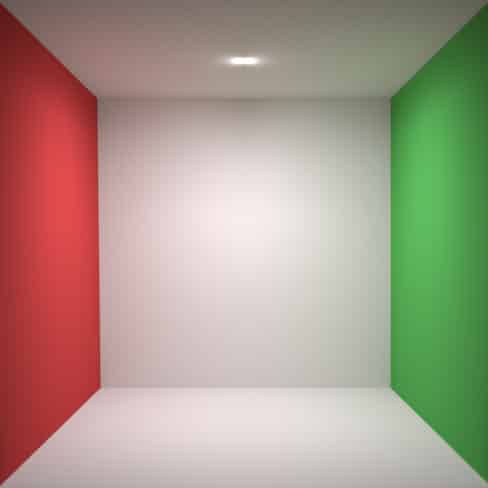
Cornell Box, simulated with a uniform directional distribution of the light source, as in the original paper

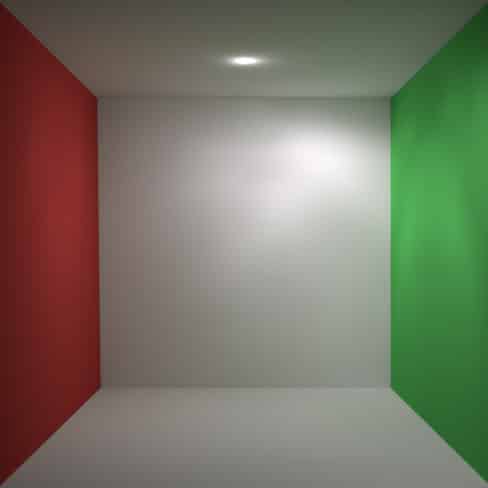
Cornell Box, simulated with a soft cone directional distribution of the light source (constant intensity within the central cone, and falloff in a broader cone)

Cornell Box, simulated with a very narrow directional distribution of the light source, generating a square highly focused beam
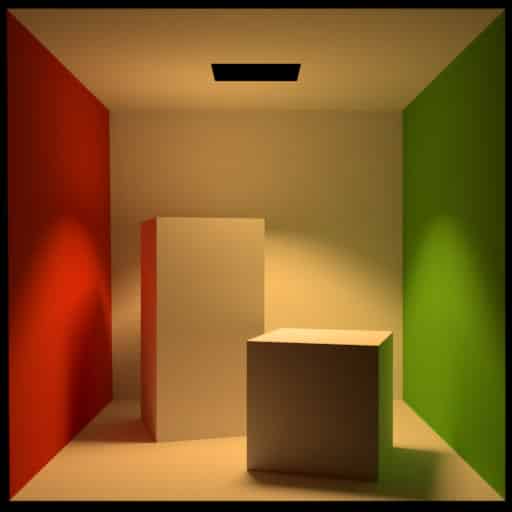
Cornell Box, simulated with a cone directional distribution of the light source

Cornell Box, simulated with a distribution of the light source in (cos θ)^5
IES light sources
- Planar IES is suited for any kind of emitting surface, and will ensure that any elementary surface will emit according to a hemispherical distribution derived from IES data, and aligned with its normal. As the distribution rotates with the surface normal, it is more suited for planar light sources. It is mostly designed for lights with no or little backwards emission, such as car lights, ceiling integrated spots, and all area lights.
- Spherical IES is suited for spherical emitting objects. It ensures that the full sphere emits according to a complete IES data. It is mostly designed for lights emitting in all directions, and not only in a hemisphere, such as candle lights, hang luminaries, non-focused bulbs, etc…
IES light sources examples

Sports flood light

Street Light

Street Light (2)
Diffuse Light

Spot Light

Indoor ceiling light
Conclusion
To summarise, Ocean™ is a versatile solution for handling complex light sources in diverse simulations and visualizations. It can handle a wide range of conditions, from replicating outdoor environments with polarized sky models to simulating artificial lighting with emitting materials.
Ocean™’s generic light source model is equipped with parameters such as base emission spectrum and distribution function, which facilitates precise representation of intricate light sources. Examples demonstrate the software’s robust performance in rendering scenes with different distribution functions while maintaining quality even with complex emitter setups.
The integration of IES light sources, including planar and spherical options, expands Ocean™’s utility for various lighting devices. Its support for different IES file types enhances compatibility across applications, making it a valuable tool in architectural and automotive contexts.
In conclusion, Ocean™ is a sophisticated and capable tool for handling complex light sources, offering flexibility and precision that are crucial for accurate simulations. As the demand for realistic lighting in virtual environments increases, Ocean™ stands out as a valuable resource for professionals, ensuring accurate representation and immersive experiences in simulated worlds.
Responses