


Why most rendering approaches fail for predictive appearance simulation:
Many rendering systems rely on RGB approximations, empirical shaders, and simplified lighting models. While these approaches can produce visually convincing images under fixed conditions, they fail when illumination spectra, material thickness, geometry, or observation state change.
In a supplementary article, we will establish that predictive optical simulation relies on spectral light transport governed by geometric optics, interface physics, and volumetric scattering. These mechanisms are inherently wavelength-dependent and can only be accurately replicated with a fully spectral engine such as Ocean™, optical simulation software. Any non-spectral model collapses this behavior into an approximation.
Predictive appearance simulation requires a complete physical chain. Geometric optics alone cannot guarantee predictive results. A reliable workflow must also integrate measured spectral material data (BRDF/BSDF, volumetric properties), accurate lighting characterization, a robust global illumination and radiative transfer engine, and perceptually grounded human vision modeling.
This article focuses on the physical mechanisms and simulation framework required to simulate real materials under real lighting conditions with physical validity. For an in-depth article focused on spectral rendering and color accuracy under real lighting, see “The importance of full light spectrum for appearance and color perception”.
Inadequacies of empirical / non-spectral approaches
Why RGB rendering fails for predictive optical simulation:
RGB-based rendering treats light as three broad channels, which implicitly assumes that all wavelengths within each band behave the same. This collapses dispersion, wavelength-dependent refraction into a coarse approximation. As a result, phenomena such as metamerism, hue shifts between daylight and LEDs, or the spectral absorption of pigments and polymers cannot be reproduced.
Moreover, the human trichromatic color vision system influences on how we perceive colors in normal lightning environments (photopic) and in dark conditions (scotopic) and these effects are not reproducible on simplified RGB rendering. Materials that appear identical on an RGB screen often behave differently in real conditions because the underlying spectral information has been lost. In short, RGB is a color space, not a physical model, since it basically renders 3 “monochrome” images, with different monochrome textures.


Illustration of metamerism on a watch case looking different when illuminated with Leds or D65, only perceptible with spectral rendering.
Why predictive simulation requires measured spectral material data:
Another source of inaccuracy stems from the reliance on guessed or artist-defined parameters. Empirical shaders cannot reproduce the directional reflectance of real surfaces, the subtle variations of gloss and haze, or the transmission behavior of architectural glazing. Predictive modeling, by contrast, requires material-specific data: refractive index spectra, absorption curves, BRDF/BTDF measurements, microgeometry characterizations, multilayer stack definitions... Without measurement-driven inputs, simulations lack physical grounding and fail to generalize under new lighting conditions.
Why simplified surface and volume models break appearance prediction:
Most visualization engines implement surface and subsurface behavior using generic approximations. Microfacet distributions are reduced to a few parameters, volumetric scattering is simplified to a blurred subsurface component, and multi-layer systems are treated as single surfaces. These shortcuts remove essential aspects of real materials: color build-up through thickness, gonio-apparent coating distribution, internal reflections within laminated glass, forward-scattering in hazy polymers, or the anisotropic sparkle produced by metallic and pearlescent flakes. When these mechanisms are simplified, the resulting renderings may be visually appealing but lose their diagnostic value.
Why incomplete lighting models invalidate material appearance:
Even a perfectly defined material appears wrong if the light illuminating it is not modeled correctly. This is often the case when daylight is approximated with an RGB texture, when LED spectra are reduced to generic color coordinates, or when luminaires are represented without their goniophotometric distribution or precise IES profile. Real illumination has a spectral and directional structure that governs the appearance of materials. A physically correct simulation must therefore account for spectral sky models, measured lamp spectra, and accurate radiance propagation.
Ocean™'s physically-true framework: a validated engineering solution
In addition to the rich spectral data processing of the materials and light sources Ocean™ applies a powerful calculation engine for the propagating rays.
Spectral radiative transport solver
Predictive spectral simulation requires light transport algorithms capable of resolving rare, wavelength-dependent energy paths. Ocean™ combines Monte Carlo and Metropolis Light Transport to address both diffuse and highly structured spectral phenomena.
Using random sampling with uniform distribution estimates the rendering equation by generating random light paths and gives immediate result that improves over time with more samples. It works well in scenes with broad diffuse illumination and easily sampled thought continuous spectral distribution.
However, when confronted to situations where light paths are very narrow (caustics, small light sources, complex indirect illumination, specular-diffuse-specular paths, dispersion, diffraction) Metropolis Light Transport (MLT) rendering technique adopts set of tools that allow samples to be statistically correlated. In other words, MLT follows an explore-&-exploit paradigm to focus sampling on relevant positions and directions.
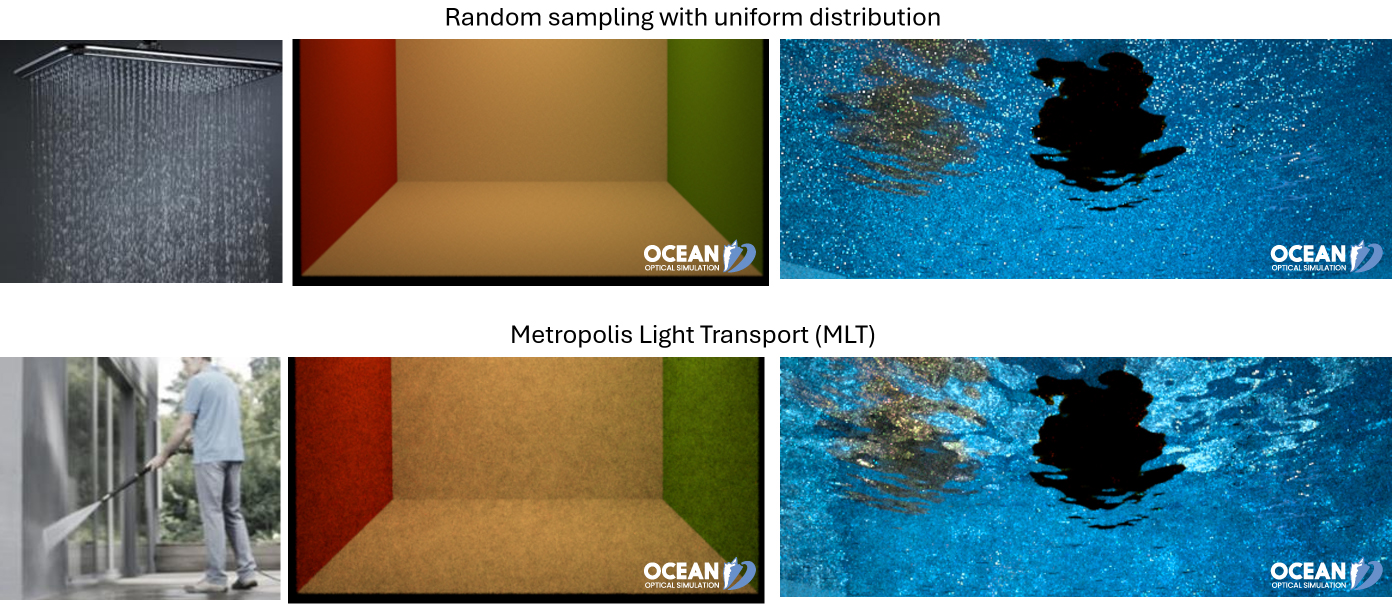
Illustration of the difference between MLT and uniform sampling for rendering complex lighting effects at equivalent rendering time.
Robust material data integration
Ocean™ computes materials optical data without transformations or approximations to ensure simulation reflects the actual material.
Moreover, the possibility to switch between random sampling with uniform distribution and MLT in Ocean™ allows to adapt the most appropriate rendering technique for the different types of scenes. For complex scenes, MLT can outperform uniform sampling spectral rendering. Meanwhile uniform sampling works better with physically correct daylight or studio lights that have broad, diffuse spectra. Properly exploiting these methods, together with the rich unbiased spectral data of the material including:
- BSDF/BRDF/BTDF data,
- n,k spectra,
- multi-layer stacks,
- microgeometry maps,
- spectral absorption curves,
- sparkle/flake distributions,
results in a physically accurate rendering under spectrally characterized lighting.
Real-world lighting simulation
Material appearance is strongly driven by the spectral and directional properties of illumination. Ocean™ models real-world lighting using: spectral daylight and sky models, measured luminaires (IES/ULD), HDR environment maps (EXR), spectral irradiance for LEDs and tunable sources, ensuring reliable observation of the material in accurate conditions.
At the same time, full spectral characterization of light sources, along with their power distribution profiles, plays a decisive role in achieving physical accuracy.
When comparing a digital sample and a real-world object, a physically true result depends as much on the accurate modeling of the lighting environment as on the fidelity of the material data itself.
Validated colorimetric pipeline (spectra to perception)
Spectral radiance must be mapped to displays with limited dynamic range while preserving perceptual accuracy. Ocean™ uses a validated colorimetric and vision model based on CIE standards (CIE 171:2006) to ensure consistent appearance across viewing conditions.
After calculating the spectral radiance distribution across the scene without approximating rays’ direction and energy transfer, simulation results should still be presented on a screen that work on RGB principle.
Even after recalculating/remapping the spectral data to XYZ color space and then to RGB color space, the simulated spectral data may appear skewed. The high dynamic range of the LCD monitor is much smaller than that of the human eye. Clearly, proper capture of luminance and chroma for any environment requires better precision than that offered by a 24-bit RGB representation.
This leads to the development of Human vision module in Ocean™ which serves the purpose to represent physically accurate lighting information in the form of High Dynamic Range (HDR) textures, environmental maps and light fields in order to capture accurate scene appearance. Simulations that are performed with three spectral functions designed to mimic human eye perception (CIE 1931 2°), allow for flexible spectral response that can characterize the HDR of a scene in any conditions.
Thus the scene can be visualized with photopic, scotopic or mesopic perception, with a tone mapping of Drago filter and glare effects according to the observer’s age and the light/dark adaptation.
As human perception is non-linear and state-dependent, spectral accuracy must be coupled with a validated perception model.
Using a physically grounded pipeline for predictive simulation with Ocean™:
RGB rendering encodes color. It does not model wavelength-resolved light transport. Empirical shaders interpolate appearance but do not propagate measured optical properties. Simplified lighting approximations ignore spectral and directional structure.
Predictive appearance simulation requires a physically grounded pipeline: spectral radiative transport, measured optical material data, realistic illumination models, and validated perception mapping.
Ocean™ integrates these components into a unified engineering framework designed not for visual plausibility, but for physical correctness across changing conditions. The result is physically true digital prototypes whose behavior can be analyzed, compared, and validated against real-world observations under any relevant lighting condition.
For a detailed explanation of the physical principles underlying spectral light transport, stay tuned for next article “Predictive optical simulation: how geometric optics enables physically true appearance modeling”
Spectral light transport and geometric optics for physically true simulation
Geometric optics provides the first-order physical description of light transport by modeling light as energy-carrying rays propagating through space and interacting with interfaces and volumes. While geometric optics alone is not sufficient to describe all optical phenomena, it defines the essential structure upon which Ocean™’s spectral radiative transfer, material interaction models, and perception pipelines are built.


Responses