The memorial for abolition of slavery

Figure 1 – The memorial entrance sign on the ground
An interesting challenge for optical simulation
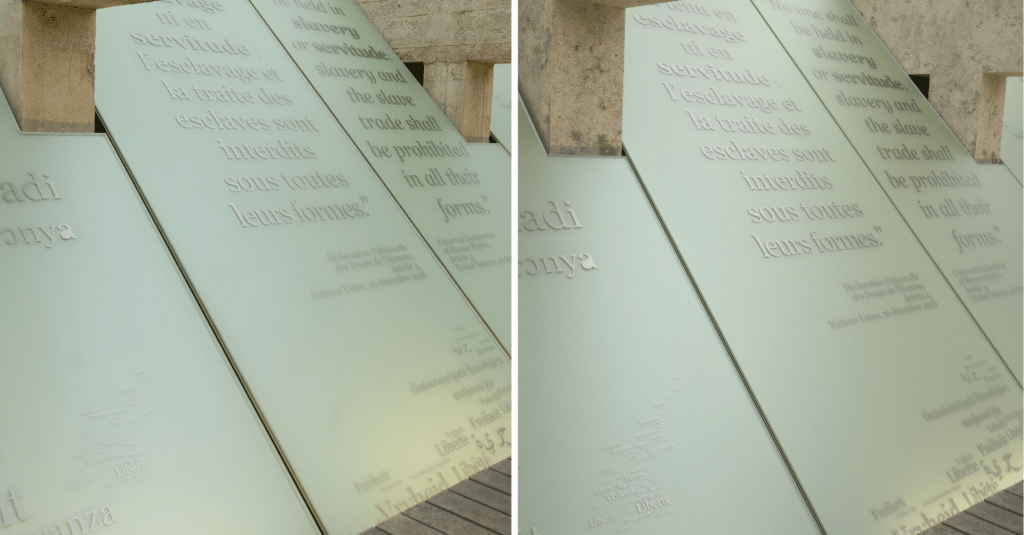
The commemorative plaques are made of high-tech glazings, featuring three sheets of glass laminated together, and including coatings, serigraphy, acid etch and paints. This gives them a unique set of visual properties, such as text appearing sometimes dark on bright, sometimes bright on dark, depending on light conditions. The crisp letters are surrounded by a soft shadow, and are faded away when viewed under high angle.
This structure is especially difficult to simulate, as most effects are caused by the multiple light bounces between the coatings, paints and acid etch layer. Therefore, this was a very interesting test subject for Ocean™ optical simulation capabilities.
Modeling the scene with complex light sources and materials
Precision Scene Modeling with Ocean™
The project CAD and technical specifications were kindly provided by Philippe Bompas from RFR, Paris, glass consultant on the project. The scene was imported and edited with Rhinoceros 3D and then computed by Ocean™.
Detailed Glazing Structure Simulation

Figure 2 – Details of the complex glazing structure used in the project
Accurate Environmental Lighting Replication
- The front glass interface is acid etched. As the roughness was unknown and difficult to measure on site, it was adjusted so that the diffusion halo of a point light source matches the real material. This is the only parameters that was fitted to match the project.
- The second interface, between glass 1 and 2, is a metallic coating deposited with a mask and defining the text of the glazings.
- The third interface, between glass 2 and 3, is a pyrolytic solar control reflective coating, whose optical properties were taken from the IGDB database.
- The last back interface is a grey paint specified by its RAL color, converted to L*a*b* values, and modelled by a lambertian material.
High-Fidelity Side-by-Side Comparison: Real vs. Simulated

Figure 3 – Comparison between picture(left) and simulation(right). The wood box enclosing the light at the lower right corner was copied from the real picture for aesthetical purposes.

Figure 4 – Comparison between picture(left) and simulation(right), in the same conditions, but from another view point
- The artificial light in the lower part of the glass was modeled very simply, it does not match the exact light set-up of the real scene.
- The glass on the real picture looks slightly bluer than the simulated image. As colorimetry was precisely calibrated, the camera is most likely not in cause. The product name of the pyrolytic coating on pane 3 was not known with certainty when modelling the glass structure, and we used a rough model for it, matching the performance and color of SGG Antelio Silver at normal incidence. The missing blue tint could be due to the product which is not the same, or to the model, which does not takes into account the specific variation of product color with angle of incidence.

Figure 5 – Comparison between picture(left) and simulation(right), in the same conditions, but from another view point
- The etched glass surface looks somewhat different, especially the highlight around “Aboli”. It seems that water flowing on the glass has modified its optical properties, by depositing materials, making the material less glossy, more diffuse. On the right picture, the vertical stripes corresponding to water flow are well visible.
- The artificial light source was again modeled using a continuous light bar, whereas it is made of smaller light sources at regular intervals on the real project.
Concluding the Simulation Success of Ocean™
Besides these observations, this proejct shows the potential of Ocean™ for designing complex glass structures. As physical prototypes are very expensive, they can be replaced by virtual prototypes simulated at early stages of development, for faster and cheaper decision-making.
Project credits
Architects: Wodiczko + Bonder
Location: Nantes, France
Consultants: Thomas Long, Design Collaboration & Visualization, Graphic Design; Snehal Intwala, Nicholas Capone, James Shen, Ryan McClain, Bill Panasuik, Emmanuelle Chérel (Research),; Patrick Charles (Design & Technical Consultant); Maximo Rohm, Ron Henderson, Michael Blier, (Landscape Consultants – USA)
Glass Consultants: James Carpenter, James Carpenter Design Associates (preliminary phase); RFR Engineurs, Paris – Philippe Bompas & Nicolo Baldassini (development & construction)
Historic Advisors: David Blight, Gilder Lehrman Center on Slavery, Resistance & Abolition, Yale University; Sven Beckert, Harvard University; Kirk Savage, Pittsburgh University; Vince Brown, Duke University
Ville de Nantes – Nantes Métropole: Jean-Marc Ayrault, Former Député-Maire de Nantes; Yannick Guin, conseiller municipal; Octave Cestor, conseiller municipal; Marie-Hélène Jouzeau, directrice Patrimoine et tourisme; Hervé Guégan, chef de projets, Atelier urbain, Nantes Métropole; Jean-Pierre Brindel, directeur Atelier urbain, Nantes Métropole; Aurélie Roger, directeur projets Atelier urbain, Nantes Métropole
Maitre D’Oeuvre: Arcadis Engineurs, Gildas Legall, Bruno Vasseur, Francois Bailly; Roulleau Architectes, Nantes – Michel Roulleau, Jean Marie Beslou
Construction: General Construction: DLE Ouest, Nicholas Boterf; Glass Wall: Polar, Torino, Paolo Cherasco; Inserts: Atelier Barrois, Brioude, Emmanuel Barrois; Lighting: Citelum, Nantes; Landscape: ISIS Espaces Vertes, Nantes; Steel/Metals: CMR, St. Nazaire, Nantes
Meet us at BAU 2025
Responses