barre logo Eclat Digital

Spectral Ray Tracing: The key to accurate daylighting simulation

accurate daylighting simulation for building with various glazing
barre logo Eclat Digital

Introduction - Accurate light analysis matters for sustainable architecture

Advanced lighting simulation allows calculating the quantity and distribution of daylight inside a room, while considering key influential parameters like material properties, exterior lighting conditions, room furniture distribution or building geometry. While many available software already enable such calculations, most of them appear to have a lack of accuracy while dealing with complex scene rendering or accurate material description.

In a detailed paper “Daylighting simulation using spectral ray tracing” published in the proceedings of the 17th IBPSA Conference,  we used our spectral rendering software Ocean™ to rigorously simulate light transport and perform accurate daylighting simulations. Thanks to its state-of-the-art algorithm, Ocean™ does not require any model simplification and allows for a physically accurate description of materials. The generated outputs allow the generation of detailed illuminance maps and realistic renderings for visualization. Here is a short summary of the detailed article:

barre logo Eclat Digital

Why conventional daylighting simulation tools fall short:

Most light modeling software relies on simplified material representations and approximate algorithms that fail to capture the true spectral behavior of light and glazing performance. These limitations include:

  • Oversimplified material properties: Many tools assume neutral transmittance across wavelengths, disregarding how materials selectively absorb, reflect, or transmit different parts of the light spectrum.
  • Limited handling of complex geometries: Architectural glazing, shading devices, and coatings often have microstructural variations that affect optical performance.
  • Approximate light transport models: Some simulation engines use assumptions that may not hold for spectrally complex materials, leading to discrepancies between simulations and real-world behavior.

Many existing solutions already enable the computation of such daylighting evaluations . […] However, […] they require to proceed with strong simplification when dealing with both complex geometry and complex material description. Such approximations may lead to a certain lack of accuracy in the calculation and so could be questionable in terms of the outputs reliability.

As a result, architects and engineers often rely on costly physical prototypes or overengineer lighting solutions to compensate for simulation inaccuracies.

barre logo Eclat Digital

How Ocean™ spectral ray tracer addresses the limitations of daylighting simulation:

Ocean™ addresses these limitations by implementing spectral ray tracing, and goes even further with bi-directional path tracing technology, an advanced computational approach that accurately models how light interacts with materials at each wavelength. This method provides:

  • Physically true light transport simulation: Ocean™ solves the full light transport equation, and uses global illumination techniques, ensuring that daylighting predictions remain faithful to real-world optics.
  • Accurate spectral representation of materials: Unlike traditional methods, Ocean™ accounts for the detailed spectral properties of glass, coatings, and architectural finishes, providing precise color and transmission predictions, as well as ensuring accurate lighting behavior analysis.
  • High-performance computation for complex structures: Ocean™ efficiently simulates large-scale models, from skylights and façades to multi-layer glazing systems, without simplifications that reduce accuracy.

Ocean™ gives a full spectral calculation from near ultra-violet to near infra-red. This specificity enables the spectral description of materials or the customisation of instrument response function, allowing a wide range of simulations and quantifications.

This capability is especially valuable for projects focused on energy efficiency and sustainable architecture certifications (e.g., LEED, BREEAM).

barre logo Eclat Digital

Case Study: Comparing architectural glazing performance with spectral ray tracing

To illustrate the benefits of spectral ray tracing, Ocean™ was used to simulate the daylight performance of various architectural glazing materials. The study examined four commonly used glass types:

  • Bronze Glass: Alters daylight spectrum, reducing blue light transmission while enhancing warm tones.
  • Blue Glass: Selectively absorbs red and green wavelengths, influencing interior lighting aesthetics.
  • Ag³-Coated Glass: Features a spectrally selective coating that optimizes thermal performance while maintaining high visible light transmission.
  • Grey Glass: Provides a more neutral shading effect, reducing overall light intensity without significantly shifting color perception.

Using Ocean™’s advanced optical modeling, these glazing materials were evaluated under real-world lighting conditions, as well as on complex 3D architectural model, revealing key insights into their spectral performance and final appearance.

Building simulations with different glass compositions.

Figure 1: Building simulations with different glass compositions.

A complete 3D building, including additional 3D objects is simulated. The office shown here in placed on the 55th floor with an East orientation. The light condition corresponds to the Brussel sky at 7 a.m., on 2019, June, 24th .

Four different glasses are used, showing the different color perceptions. The red rectangle identifies the computer screen on which the measurements provided in this proceeding are made. The blue rectangle identifies a white sheet of paper on which colorimetric measurements are made.

Irradiance simulations of different glazing performances

Figure 2: Irradiance simulations,i.e. how much light is incoming visible surfaces,obtained foreach glass. The color scale is in W/m².
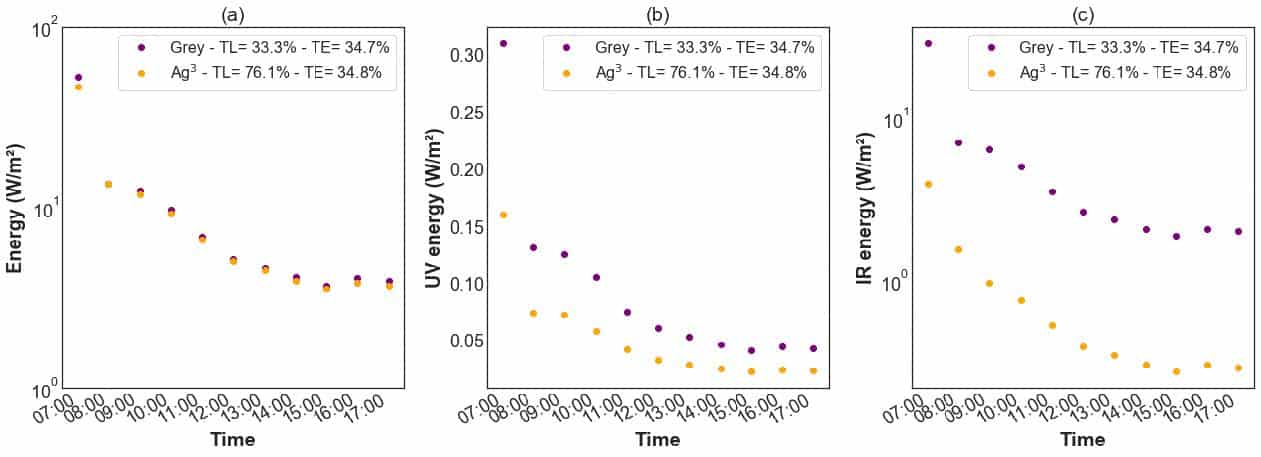
Energy received by one computer screen as a function of the time and for different wavelength domain

Figure 3: Energy received by one computer screen as a function of the time and for different wavelength domain :Total energy range (290-2500 nm), UV range(290-390 nm) (middle) and infrared range(700-2000 nm) (right).
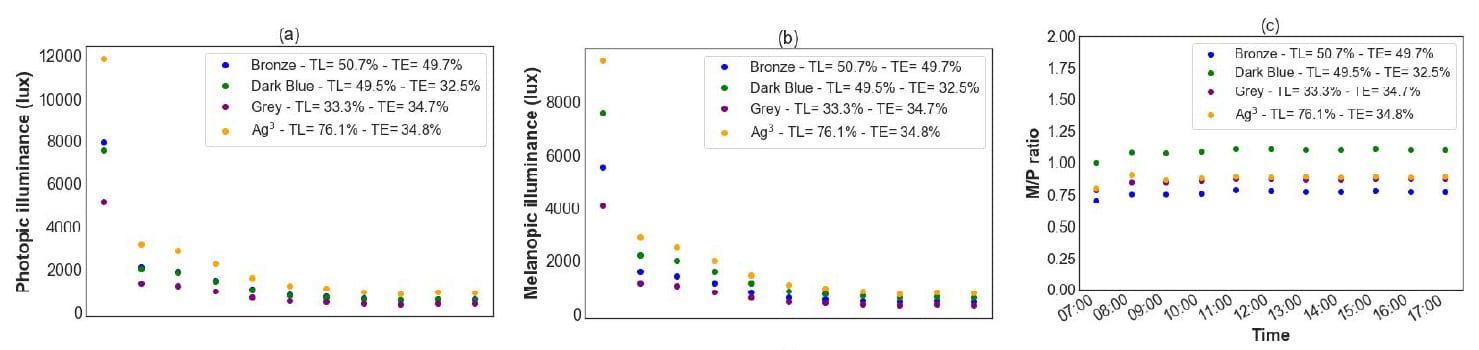
Photopic, melanopic illuminance and M/P ratio

Figure 4: Photopic (a) and melanopic(b) illuminance and M/P ratio (c) received by one computer screen as a function of the time. The photopic and melanopic illuminances were obtain by integrating the transmitted light spectrum over the response function given in figure 4 and by multiply those values by 683lm/W², which corresponds to the photopic eyes efficiency

The results highlight the importance of spectral accuracy in lighting simulations, enabling architects and engineers to make informed material selections that align with design intent and sustainability goals.

barre logo Eclat Digital

Why spectral ray tracing is a game-changer for building design and material Innovation

By integrating spectral ray tracing into lighting design workflows, Ocean™ provides:

  • For Architects: Realistic daylighting previews that improve decision-making in facade and interior design.
  • For Engineers: Precise spectral evaluations to optimize material performance for energy efficiency and aesthetics.
  • For Manufacturers: Enhanced product development through virtual prototyping, reducing the need for costly physical mock-ups.

For more details on Ocean™’s software capabilities, visit our product page or explore our previous blog articles on optical simulation and architectural rendering.

barre logo Eclat Digital

Conclusion - Key takeaways: Enhancing architectural design with advanced light simulation

Spectral ray tracing represents a major leap forward in lighting analysis, ensuring that architectural glazing choices are based on scientifically accurate predictions rather than approximations. Ocean™ enables architects, engineers, and manufacturers to achieve superior daylighting performance while optimizing energy efficiency, occupant comfort and sustainable design strategies.

The approach described here could also easily be used to derive traditional optical characteristic of transparent system like light, energy, UV, IR,… transmission coefficients. While this is probably an over-kill for simple glazing systems as the ones considered in this study, it could be interesting for more complex systems (e.g. fritted glass, lover system, diffusive systems,…). For such system simplified calculation methods often fall short and a fully spectral ray tracing approach would allow to evaluate said indicators quickly and easily.

By considering wavelength-dependent material properties, Ocean™ enables more reliable daylighting impact assessments, facilitating data-driven design decisions for enhanced architectural performance.

barre logo Eclat Digital

Read the full article:

whitepaper accurate daylighting studies with spectral ray tracing
barre logo Eclat Digital

Explore other articles about glass and architecture:

Read more about architectural application of our software Ocean™:

barre logo Eclat Digital

Need more information? Contact us:

barre logo Eclat Digital

Q&A

Spectral ray tracing is an advanced computational technique that simulates the interaction of light with materials across different wavelengths. Unlike conventional optical modeling software, which often assumes neutral transmittance, spectral ray tracing with Ocean™ considers the precise optical properties of glass, coatings, and architectural surfaces, leading to high-precision daylight analysis in terms of color accuracy, illuminance distribution, and energy efficiency.

Most daylighting simulation tools simplify material descriptions and rely on approximations that may lead to inaccurate results. Ocean™ uses full spectral ray tracing, enabling precise modeling of light transport without model simplifications. This allows architects and engineers to achieve physically accurate daylighting analyses, reducing reliance on physical prototypes.

Spectral ray tracing is particularly valuable for materials with complex optical properties, such as:

  • Architectural glazing (e.g., tinted, coated, or multi-layered glass)
  • Shading devices and louvers with spectral selectivity
  • Diffusive materials like frosted glass and translucent panels
  • Specialized coatings that affect light absorption and reflection

By providing highly accurate daylight behavior predictions, spectral ray tracing helps architects and engineers make informed material selections that maximize natural lighting, reduce artificial lighting dependence, and improve building energy performance.

Yes! Ocean™ not only ensures precise daylighting predictions but also generates high-quality, physically-true renderings that accurately represent how spaces will look under different lighting conditions. This is particularly useful for design validation, client presentations, and marketing visuals.

barre logo Eclat Digital
The latest
barre logo Eclat Digital

Blog articles

Responses